
Kids & Adults Go for Emerald City


Visitors to the FfOR table at Eco Expo talked about the Public Promenade -- our park on the bluff overlooking the 3rd largest river in the world. They looked at its current state, future opportunities, and colored it clean, green, and fun for the future.

The Promenade runs from Union Ave. north to the Mud Island monorail station and from the river to Front Street. For more information about the park - its history, the current threat it faces, and the opportunities it holds - read through the left-hand menu bar. And if you haven’t signed up yet to help protect our public land and revitalize the Memphis riverfront, click here to get involved.

[Click here to read more...]

Paris - Bikes for Rent


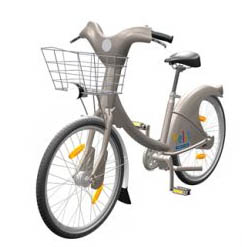
Memphis is topographically flat, an easy ride for bikers. So is Paris, and there renting Velib' bikes has taken hold as an inexpensive, stylish, and people-friendly way to get around the city.

In Memphis Midtown Bike has moved downtown (509 S. Main) and starting in April or May will offer bike rentals. Other cities are paying careful attention to Paris; San Francisco (yes, it is hilly there) will start a bike sharing program in 2009. Click below to read about the Velib' in Paris.


A New Fashion Catches On in Paris: Cheap Bicycle Rentals
By Steven Erlanger with Maia de la Baume and Basil Katz
New York Times, Published: July 13, 2008

PARIS — They’re clunky, heavy and ugly, but they have become modish — and they are not this season’s platform shoes.

A year after the introduction of the sturdy gray bicycles known as Vélib’s, they are being used all over Paris. The bikes are cheap to rent because they are subsidized by advertising, and other major cities, including American ones, are exploring similar projects.

About 20,600 Vélib’ bicycles are in service here, with more than 1,450 self-service rental stations. The stations are only some 300 yards apart, and there are four times as many as there are subway stations, even in a city so well served by its metro system.

In the first year, the city says, there have been 27.5 million trips in this city of roughly 2.1 million people, many of them for daily commutes. On average, there are 120,000 trips a day. And on July 27, at the conclusion here of the Tour de France, 365 lucky Vélib’ riders will be chosen to ride along for a while and cross the finish line.

There are a Vélib’ Web site, Vélib’ fashions and a Vélib’ blog ; one recent posting discussed the best way to ride with a skirt. A kind of Vélib’ behavior has emerged, especially at the morning rush, with people swiftly checking for bikes in the best condition: tires inflated, chains still attached, baskets unstolen.

Natallya Ghyssaert, a 34-year-old doctor, has an annual subscription for 29 euros (about $46), which lets her use a bike whenever she wants for 30 minutes at a time without extra charges. She uses a Vélib’ two or three times a day, saying, “I love it; you can see Paris, you can exercise and stay out in the light of day.”

The Vélib’ — a contraction of vélo for bike and liberté — can also be rented for a day or for a week, with a 150 euro (about $239) deposit taken from the user’s credit card if the bike is not returned. Usage fees over 30 minutes can rise steeply: two hours costs 7 euros (about $11). But 96 percent of all rides are less than 30 minutes, because bikes can be returned to any station.

No one knows quite how many trips by car or taxi are thereby avoided, but the “eco-friendly” nature of the Vélib’ has been much promoted in a country where juice companies warn of the risks to “our fragile planet” in lavish brochures on thick paper.

Benjamin Tomada, 30, a cook parking his Vélib’ near the Music Hall restaurant where he works, said: “I have a car but I don’t use it. It’s always better to take a bike than the metro.”

Still, there have been significant problems with traffic congestion and safety, vandalism and theft. At least 3,000 of the bikes have been stolen — nearly 15 percent of the total, and twice original estimates. Some have been seen in Romania or found in shipping containers on their way to Morocco.

Wearing helmets is not compulsory in France, and three people have died on their rented Vélib’s, hit by buses or trucks.

The Vélib’ program in Paris was conceived by the Socialist mayor, Bertrand Delanoë, and the 10-year contract was won by JCDecaux, a major French public relations and advertising company with good political contacts, after defeating a rival bid from Clear Channel.

The deal is supposed to be good for Paris, but it promises to be extremely lucrative over time for JCDecaux.

Decaux got to erect 1,628 billboards to rent; it invested nearly $142 million to set up the rental bike system and the billboards, and must provide maintenance and replace stolen bikes; the city of Paris gets the proceeds from the usage of the bikes plus some royalties from Decaux.

So far, according to Rémy Pheulpin, the company’s executive vice president, it has put up 1,500 billboards in a year and expects to make about $94 million a year from them. The company stands to begin turning a considerable profit if not next year, then in the third year of its 10-year contract.

The city has received $31.5 million from subscribers and users of the bikes, plus an additional $5.5 million a year, fixed in the contract, from advertising royalties, according to Céline Lepault, the Vélib’ project manager for City Hall.

Mr. Pheulpin, whose company built similar but much smaller programs in 10 other cities, like Lyon and Rouen, said the company had learned that there were several keys to success: allowing subscriptions, so people get the sense that the bikes are free once they have paid their up-front fee; making sure the bike stations are ubiquitous and keeping the system “user-friendly.”

[Click here to read more...]

Streets - what's happening to make New Yorkers "love" them

It used to be that streets were thought of solely as a way to move cars, and the faster the better. Today their role is shifting and expanding.

NYC Commissioner of Transportation Janette Sadik-Khan, who often rides her bike to work, is a leader in the government’s new view of the role streets can play as public places. Her city’s streets were recently picked as a reason to love NY. Click below to read why and about a transportation workshop on streets for the future.


Because Robert Moses Would Have a Coronary If He Were to See Our Streets Now
By Justin Davidson
Published Dec 14, 2008, “New York Magazine”, Reasons to Love NY
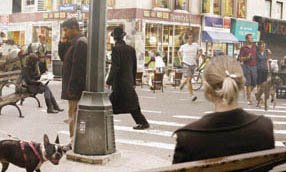
Photo-montage by Paul Poseidon.

New York’s streets are getting new ownership. Lane by lane, curb cut by parking space, in steps so scattered and incremental that they hardly get noticed, people on foot are wresting control of the asphalt from those behind the wheel. Even on a chill winter day, you can take a sandwich and a book and sit in a sunlit patch on Broadway between Times and Herald Squares—not at a curb café but in a lane that once belonged to cars. A strip has been painted tan, flanked by planters, and sprinkled with metal chairs and tables. On one side of this oasis, cyclists speed down their own green lane. Vans and trucks park on the other side of the planters, barricading the new plaza from moving cars. Having lunch in the middle of Broadway can be disconcerting, but it sends a signal of pedestrian pride.

For decades, it was almost inconceivable that any American city would requisition turf from motorized vehicles and turn it over to people who would use it for such low-speed, inefficient activities as strolling or sitting around. Robert Moses, who didn’t drive, nevertheless believed that the well-made street should speed the car. That long-unchallenged assumption has found an opponent in Commissioner of Transportation Janette Sadik-Khan, who last year hired Jan Gehl, the Danish guru of pedestrianism, to help transform traffic arteries into more-textured public places.

In the twenty months since Sadik-Khan took office, she has swiftly refashioned miles of streets, using inexpensive materials and commando operations. The commissioner often commutes by bicycle, and she made sure her two-wheeled people got their very own slice of Ninth Avenue in Chelsea, delimited by the curb on one side and a landscaped median on the other. Where the avenue widens at 14th Street, a low-tech armory of heavy planters, paint, and metal chairs has secured a pleasant haven in the middle of southbound traffic. Two blocks farther downtown is Gansevoort Plaza, where blocks of salvaged granite arranged into funky seating and a phalanx of spherical, nippled bollards protect a new pedestrian habitat. Across town at Madison Square, another loiterer’s haven has sprouted at an intersection that once was clogged with traffic.

Behind such tinkering with blacktop and hardware is an attempt to change the way people see and use their city. Sadik-Kahn has been called a “guerrilla bureaucrat,” and her experiments do have a revolutionary cast. On Saturday mornings last summer, vehicles started to vanish from various streets—without being replaced by tired fairs. First, in local actions taken under the city’s approving eye, parts of Montague Street in Brooklyn Heights and Bedford Avenue in Williamsburg became temporarily pedestrian. Then, for three Saturdays in August, a seven-mile stretch of Manhattan from the Brooklyn Bridge up Park Avenue to 72nd Street was transformed into a motor-free allée. Children played in the street, a brass ensemble oompahed, adults scooted along on their kids’ Razors, and Pomeranians promenaded down the center lane.

Public space comes in a range of shades. In the sixties, its cultivation was effectively delegated to private developers, who were permitted to put up bigger office buildings if they provided sidewalk-level oases where workers could eat their lunch. In the eighties and nineties, New York began to rejuvenate its parks, restoring enclaves that offer a cushion from noise and congestion. Now the Department of Transportation has realized that its jurisdiction covers the basic unit of urban life: the street. There, lifestyles intersect and city dwellers co-exist with people different from themselves. It’s where we learn toleration, where leisure shares space with urgency, commerce with activism, baby carriages with handcarts. When it is narrowed by garbage or overwhelmed by traffic, then the street reverts to its most primitive use: as a corridor. But a truly public place allows people to move at many different paces, or not to move at all.

A course on how to build streets for the future -- Project for Public Spaces (PPS), is offering a two-day transportation course, Streets as Places, on April 2-3, 2009 in NYC to introduce participants to new ways of thinking about streets. The course is geared to anyone interested in creating a great street, including transportation professionals who want to learn more about how streets can contribute to better communities; civic and elected officials who realize the social and economic benefits that can result from changing the way that roads are designed; and citizen activists who understand that the time for change is now. Click here for more information.

[Click here to read more...]

Lendermon responds to suggestion

Click below to read Benny Lendermon's response to Joe Royer's riverfront suggestion. It leads to an idea -- 2 projects that Memphis should put on its stimulus package wishlist.

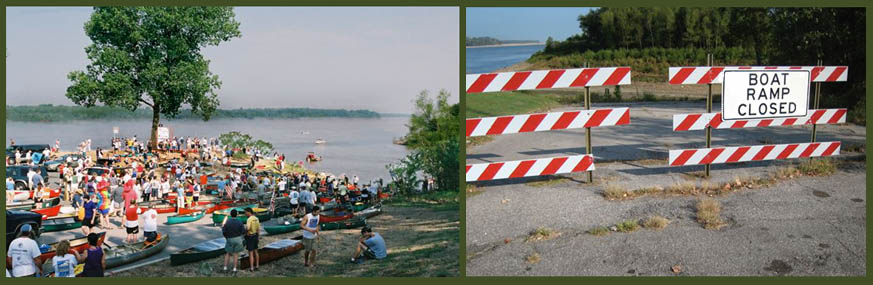
The boat ramp being discussed is on the North end, MS River side of Mud Island's Greenbelt Park.

February 6, 2009
Dear Joe:

Thank you for your continued interest in and use of the Memphis Riverfront. As you know, we value the input of all citizens and take concerns and suggestions very seriously. In fact, you and I have discussed rebuilding the boat ramp at the north end of Greenbelt Park several times before.

The Riverfront Development Corporation (RDC) certainly supports the inclusion of a new launching area along the riverfront. We believe it makes sense to construct it as part of the Wolf River Greenway project, which would tie a launching ramp into the greenway.

However, the construction of such a launching area will not be as easy as you might expect. The former ramp washed out due to the instability of the river bank in that area. Nearly five years ago this same unstable soil caused major concerns for the MLG&W power lines crossing the Wolf River adjacent to the old ramp. The cost of shoring up this bank was about $250,000 back then. A similar improvement would be necessary as part of any new boat launch design and construction.

Another issue that exists is the delta that forms at the mouth of the Wolf River each summer during low water. This naturally occurring phenomenon makes the water too shallow for self-powered boats to access the Mississippi River due to the lack of depth in the water. Perhaps one way around that issue is not to allow larger boats to use this ramp in low water or maybe just build a launch area for canoe and kayak use only. Of course this restriction would still not solve the larger access issue.

The RDC is aware of these concerns and is actively looking for ways to increase and enhance access to the Mississippi and Wolf Rivers. As an avid user of the river, I take a personal interest in this issue. Certainly you know as well as anyone that I have always been a huge supporter of providing more boating access to the Mississippi River. Together, I'm sure, we'll be able to plan, design, and construct a suitable solution. It just takes time, cooperation, and funding.

Again, we appreciate your bringing this important topic to the forefront of the community discussion.

Sincerely,
Benny O. Lendermon, III
President


Memphis' wishlist -- Sounds like the Wolf River Greenway and rebuilding the boat launch would make excellent projects to submit for funding in the federal government's new stimulus package.


[Click here to read more...]

Riverfront Suggestion


The goal -- make Memphis a better city. Here’s a riverfront suggestion from outdoor enthusiast Joe Royer. In a letter to Benny Lendermon, he asks the Riverfront Development Corp., to consider rebuilding the boat ramp at the North end of Mud Island.

Benny,

Would you please consider rebuilding the boat ramp at the North end
of Mud Island?

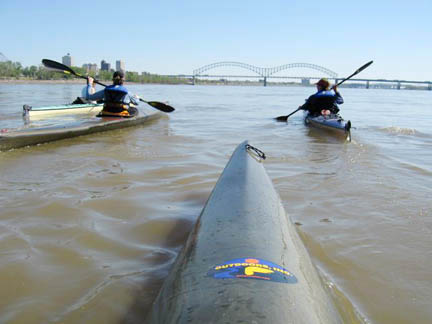
I've talked to the two canoe clubs in town, the Wolf River Conservancy, and a few more paddling friends. We know of over 3000 trips between the mouth of the Wolf River and the harbor by canoe and kayak for 2008.

As you probably know, I paddle most days up to the mouth of the Wolf
in my daily work out. I see several fisherman and hunters using the
TWRA ramp. They struggle in the swift current and wind. Their boats
are always being banged around. The fisherman and hunters would
love the easier access.

As a graduate from the Civil Engineering Dept. of the U of M, I have
deep respect for engineering design skills. Making this work, even
with an unstable bank, could easily be done. Everything on Mud Island is
unstable.

A new well designed boat ramp could also be an aid to stabilizing the
area near the power lines.

Maybe this could be part of the stimulus package.

Thanks for considering my idea.
Joe Royer

[Click here to read more...]

Sights we don’t often see


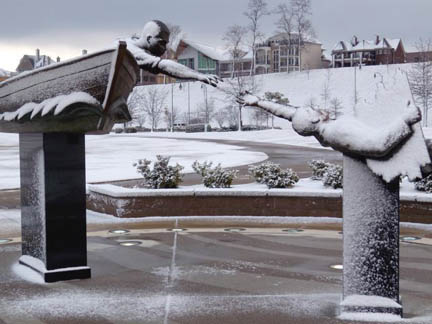
Snow covered Tom Lee Park this past week, and a Friend sent this beautiful and unusual photo.


And while you’re thinking BRRRrrrr - COLD,
consider a plunge in the Mississippi at the Special Olympics Polar Bear Plunge & Chili Cook-off, Feb. 7 on Mud Island River Park. Or, if you prefer, just come watch, cheer, and enjoy the chili. Click here for information.

[Click here to read more...]